Can tissue-free ctDNA detect breast cancer relapse early?
A retrospective c-TRAK TN analysis found tissue-free ctDNA predicted TNBC relapse, but clinical benefit and NHS implementation remain unproven.
Data and technology for cancer care
A retrospective c-TRAK TN analysis found tissue-free ctDNA predicted TNBC relapse, but clinical benefit and NHS implementation remain unproven.
Tamsin Nash is beginning the third year of her Clinical Research Training Fellow in TRACC programme at the University of Edinburgh. Her research explores socioeconomic and ethnic disparities in the quality of cancer care. But what do we mean by “quality of care” – how is it actually defined within health systems, and what metrics […]
Hazard ratios assume uniform benefit, but anthracycline’s absolute benefit and cardiac harm both depend on baseline risk, not the ratio itself.
Most cancer drugs granted accelerated approval by the US Food and Drug Administration between 2013 and 2017 still had no demonstrated survival or quality-of-life benefit by mid-2023 (Liu et al., JAMA, 2024). Through Project Orbis the MHRA now reviews many of the same applications concurrently with the FDA, so drugs arrive in England and Scotland […]
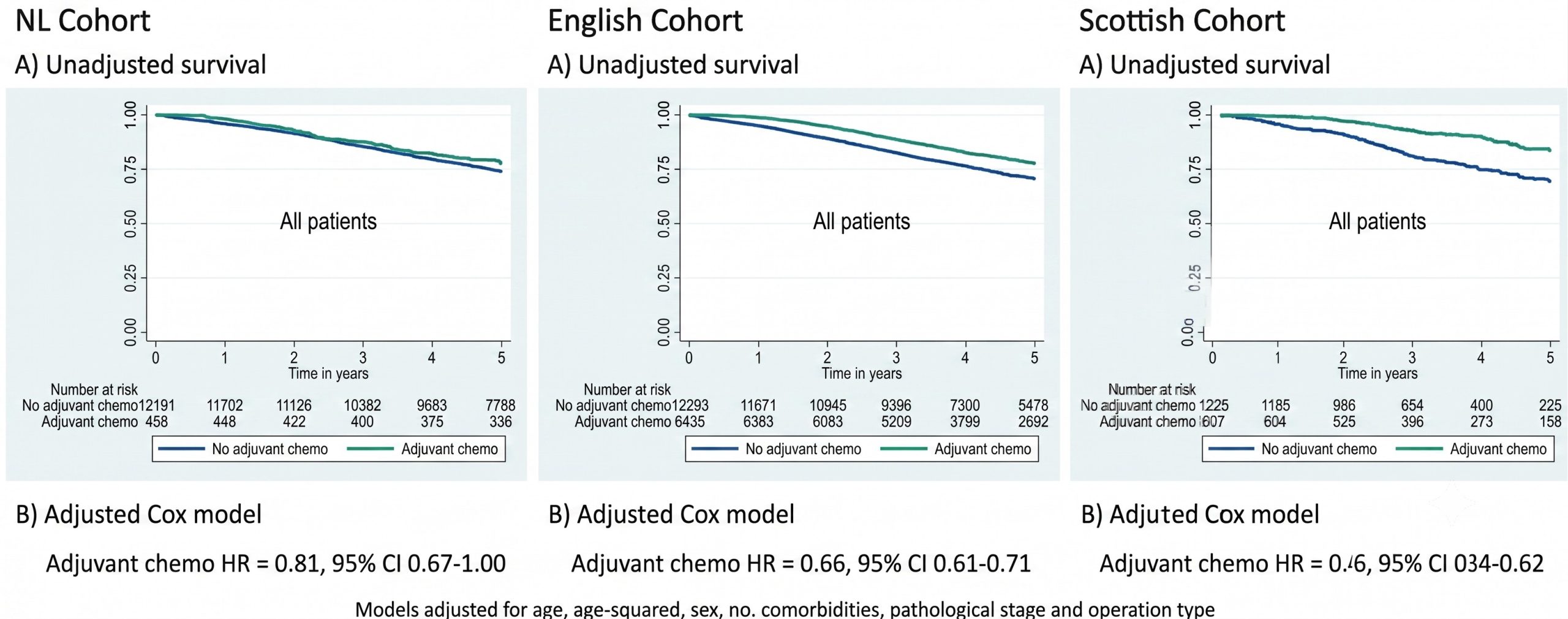
Adjuvant chemotherapy after radical resection for rectal cancer was associated with lower mortality at five years in all three national cohorts of a new international analysis. In the Scottish cohort of 1,833 patients the adjusted hazard ratio for death at five years was 0.50 (95% CI 0.37 to 0.68), in the English cohort of 18,729 […]
By Nicola Symmers, Developer. Edinburgh Cancer Informatics has built a data lineage and exclusion audit framework into the process that produces our OMOP Common Data Model. For every record that could have entered the model, the framework records whether it was loaded or excluded, which source dataset, row and column it came from, and, where […]
Colin McLean, Senior Data Scientist for the Data theme of the CRUK Scotland Centre, is among the authors of a new perspective piece in the European Journal of Cancer. “From bench to byte: A UK perspective on data-driven cancer research” was written by the leads of Cancer Research UK’s Data Interest Groups and sets out […]
eCRUSADers has published a detailed researcher experience post from our TRACC Clinical Research Fellow Tamsin Nash, describing the process of building a linked dataset for her PhD on socioeconomic and ethnic disparities in cancer care quality. The cohort comprises around 500,000 patients diagnosed with cancer in Scotland between 2009 and 2024, drawn from SMR00, SMR01, […]
An editorial in ESMO Real-World Data and Digital Oncology by Sam McInerney, Peter Hall and Kathrin Cresswell argues that the barrier to large language models in oncology is not model performance but whether strained health systems can assess, validate and sustain them. Using clinical trial matching and ambient documentation as worked examples, the authors show […]
A new population-based study led by our PhD student, Glasgow-based neurologist Emanuela Molinari has found that people who survive cancer diagnosed before the age of 40 face a sustained higher risk of mental health problems for many years after treatment. Published in Psycho-Oncology, the study used linked NHS records from the Lothian region of Scotland […]