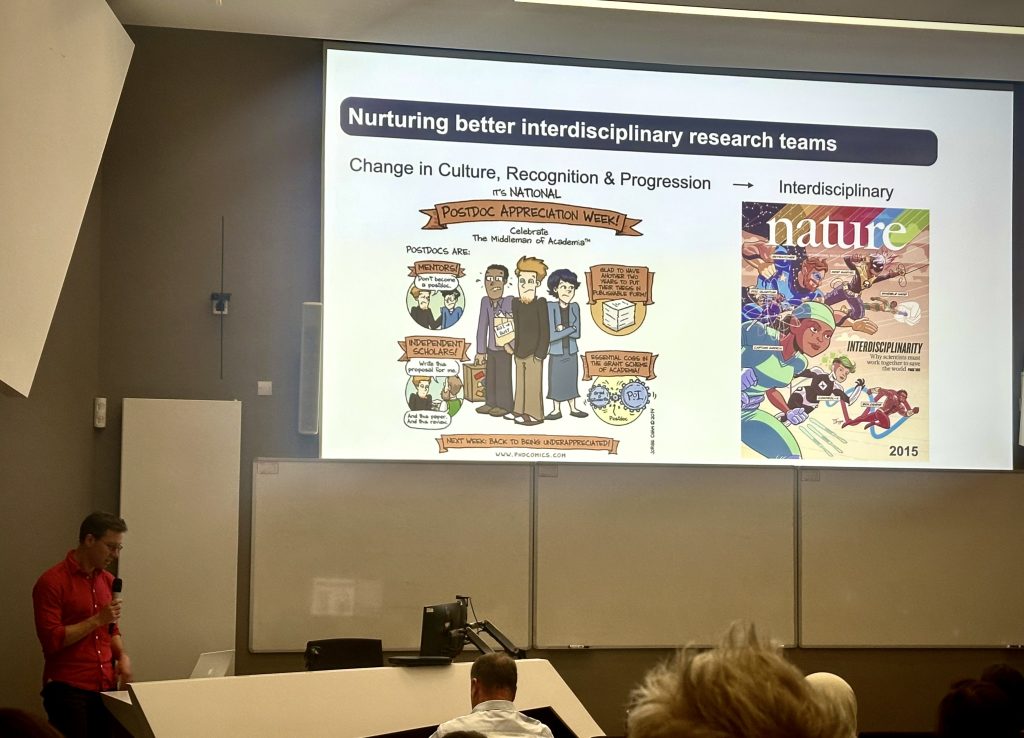
Edinburgh Cancer Informatics’ Colin McLean presented at the Cancer Research UK Scotland Centre Annual Meeting on 11 September 2026, sharing his work on building a stronger community for data science and interdisciplinary cancer research.
The meeting, held at the University of Edinburgh’s Institute of Genetics and Cancer, brought together researchers from across the CRUK Scotland Centre to look back at the Centre’s work from 2022 to 2026. Colin’s talk, “Community building through the CRUK Scotland Centre”, formed part of a session showcasing Centre-funded research and activities.
A central theme of the presentation was that modern cancer research increasingly depends on people who work across traditional disciplinary boundaries. Biomedical data scientists bring computational, mathematical and statistical expertise into biological, medical and health research, but making biomedical research successful requires more than technical skills alone.
Colin highlighted the importance of creating the right culture, recognition and career progression for people working in interdisciplinary roles. Building strong research teams means recognising contributions that may not fit conventional academic career structures, while nurturing inclusive, supportive and positive working environments for researchers with different expertise to work together effectively.
The presentation also placed this work within the development of CRUK’s Data Science & AI Talent Strategy. The journey from the organisation’s 2022 Research Data Strategy has included consultation with the cancer data science community, unconferences, discussions around training and careers, and work to understand how AI and data science capabilities can be developed across cancer research.
The resulting direction puts people alongside technology: supporting skills and training, strengthening interdisciplinary teams, and developing a connected national research community capable of using data and AI to improve cancer research.
For Edinburgh Cancer Informatics, these questions are particularly relevant. Cancer informatics sits at the intersection of healthcare, data science, statistics, software and cancer research, and much of our work depends on sustained collaboration between people with very different professional backgrounds.
Colin’s presentation was a reminder that building the future of cancer data science is therefore not simply about developing better methods or generating more data. It is also about building the communities, career pathways and research environments in which interdisciplinary work can thrive.