Hazard ratios hide who benefits from anthracyclines in early breast cancer
Hazard ratios assume uniform benefit, but anthracycline’s absolute benefit and cardiac harm both depend on baseline risk, not the ratio itself.
Data and technology for cancer care
Hazard ratios assume uniform benefit, but anthracycline’s absolute benefit and cardiac harm both depend on baseline risk, not the ratio itself.
Innovative new medicines used in conjunction with neoadjuvant chemotherapy (NACT) may lead to a higher pathological complete response (pCR), and therefore a better chance of survival for patients diagnosed with eTNBC cancer. The Edinburgh Cancer Informatics, in partnership with DATA-CAN, ran a retrospective, longitudinal cohort study using routinely collected data to better describe differences in […]

In an effort to better describe patients affected with node-positive HR+, HER2− early breast cancer, the Edinburgh Cancer Informatics conducted a retrospective study looking at the demographic and clinical characteristics of these patients in South-East Scotland, in a real-world setting. Long term outcomes and treatment profiles were also reported, along with healthcare utilisation. Such audits are […]
Data Scientist Giovanni Tramonti has produced an implementation of the NHS Predict decision tool for batch processing. Available on the R CRAN. This is useful for producing a patient-level mortality risk estimate from breast cancer staging information. https://cran.r-project.org/web/packages/nhs.predict/index.html
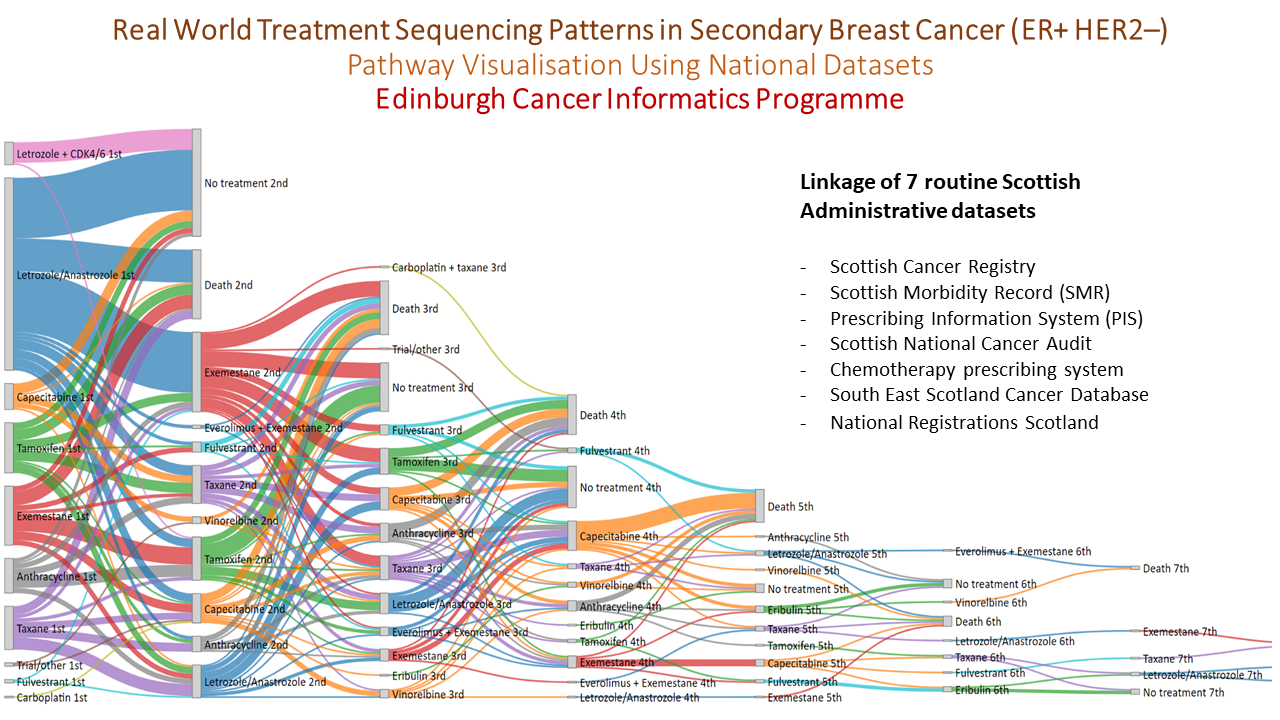
Edinburgh Cancer Centre Oncology Specialty Registrar Ashley Horne @AshHorne1983 used data visualisation to demonstrate the power of Scottish prescribing data for complex treatment sequencing in metastatic breast cancer at the 2019 European Society of Medical Oncology annual conference. Full poster: ESMO_2019_Optimized